
The New Golden Mile is becoming part of a new geography of living in southern Europe, shaped by geopolitical uncertainty, remote and hybrid work, changing priorities after Covid and a greater emphasis on quality of life. Positioned between Málaga and Gibraltar, the area combines international connections, healthcare, education, digital and professional infrastructure, climate, nature and year-round leisure.
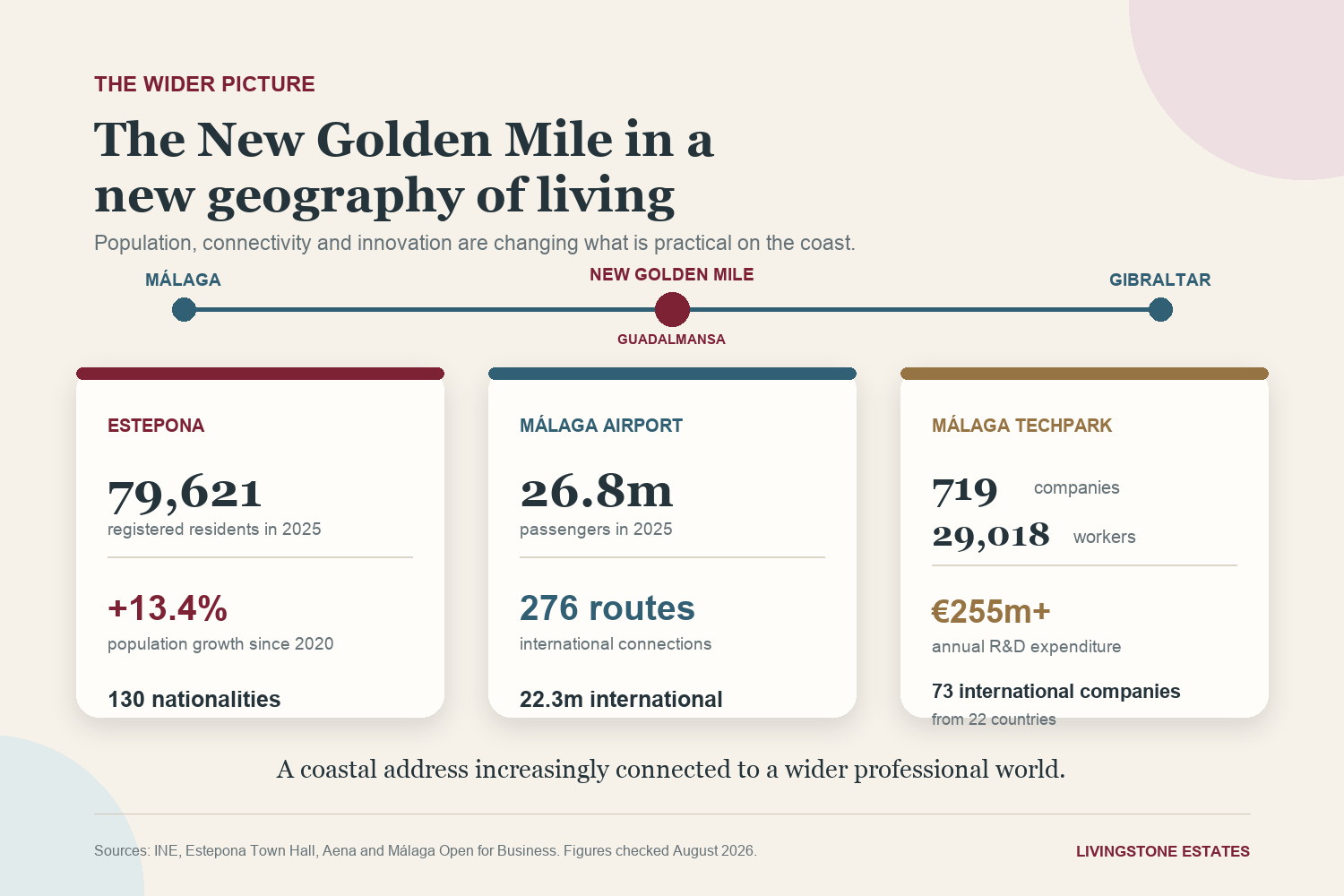
The demographic change is already visible. Estepona's registered population increased from 70,228 in 2020 to 79,621 in 2025, while approximately 130 nationalities now live in the municipality. What was traditionally regarded as a holiday destination is increasingly becoming a practical international base.
Why is the New Golden Mile attracting more year-round residents?
The change is not explained by property demand alone. Political tension, armed conflict, economic uncertainty and changing tax environments have encouraged internationally mobile families to think more carefully about where they spend their time. A second residence can now serve as an alternative European base if it offers stability, dependable services and easy international connections.
According to the Spanish National Statistics Institute, Estepona's population grew by approximately 13.4% from 2020 to 2025. The Estepona Town Hall reported in 2026 that 130 nationalities live in the municipality.
The wider corridor has a similar international character. Marbella recorded 173,420 residents in January 2026, with foreign residents representing 31.04% of its population.
International purchasers also accounted for 34.3% of residential transactions across Málaga province in the first quarter of 2026, according to the Spanish Land Registrars. This provincial figure is not a New Golden Mile buyer profile, but it confirms the importance of international demand.
How have remote work and Covid changed residential priorities?
Covid did not invent remote work, but it proved that many responsibilities could be managed without one permanent office. In the European Union, the proportion of employed people who usually worked from home rose from 5.5% in 2019 to 13.5% in 2021, according to Eurostat. Hybrid arrangements and international teams have since become more familiar.
This audience is not adequately described by the familiar digital nomad label. Many are established entrepreneurs, consultants, researchers, creative specialists and senior professionals whose work is international but no longer tied every day to a single office.
Some work remotely for organisations based elsewhere; others divide their time between homes, offices, clients and business interests in several countries. They are not necessarily looking for a temporary escape. They need a well-connected home that can function as a dependable base for work, family life and longer periods of residence.
Málaga's expanding technology and research economy adds another dimension. The coast is not only attracting people who bring their work with them. It is also becoming relevant to professionals who want access to local business networks, specialist talent, research partnerships and an increasingly international innovation community.
Covid also changed the way many people value time. Nature, outdoor living, exercise and family life are no longer automatically postponed until retirement. Quality of life has entered present-day planning, alongside work, education and healthcare.
How connected is the New Golden Mile to the wider world?
Málaga has changed what is practical on the Costa del Sol. Its airport handled approximately 26.8 million passengers and 276 routes in 2025, including 22.3 million international passengers. For residents with professional and family connections in several countries, the scale of this network is a material advantage. Current airport data are available from Aena.
Málaga María Zambrano adds high-speed rail connections with Madrid and other Spanish cities. The coastal commuter railway, however, finishes at Fuengirola. Marbella, Estepona and the New Golden Mile remain dependent on the A-7 and AP-7, so the position of a home can make a noticeable difference to everyday journeys. See Renfe's Málaga network.
Gibraltar provides a second airport with direct connections to several British cities. Under the UK and EU agreement provisionally applied from 15 July 2026, routine passport checks were removed at the Gibraltar-Spain land frontier.
It is too early to predict the long-term effect, but more fluid movement could strengthen the practical relationship between Gibraltar, Sotogrande and Estepona. The documents are available from the UK Government.
Digital connectivity completes the picture, although fibre availability should always be confirmed for the individual building. Málaga's economy is also extending beyond its traditional dependence on tourism.
Málaga TechPark closed 2025 with 719 companies, 29,018 workers and combined turnover of €4.896 billion. Research and development expenditure exceeded €255 million, supporting 3,275 direct R&D jobs, while 73 international companies from 22 countries employed approximately 8,000 people.
Together with the University of Málaga and growing activity in cybersecurity, artificial intelligence, biotechnology and advanced engineering, this gives the region a professional ecosystem capable of attracting companies, researchers and internationally mobile talent. Málaga Open for Business provides the latest figures.
Does the area work for everyday life throughout the year?
Airports make arrival possible, but longer stays depend on healthcare, education, shopping and ordinary services. Estepona East provides access to public and private care, including the Hospital de Estepona, Hospital Universitario Costa del Sol and several private hospitals and clinics. Our healthcare guide for Estepona explains the principal options.
International and bilingual schools, supermarkets and professional services support family life. Estepona, Marbella and Puerto Banús extend the choice of restaurants, culture and shopping, while golf, racquet clubs, marinas and the coastal path provide year-round leisure. Our Estepona East guide covers these amenities in greater detail.
Long-term records from Spain's State Meteorological Agency show an annual average of 2,905 sunshine hours at Málaga Airport. This makes walking, golf, outdoor lunches and time on a terrace realistic for much of the year.
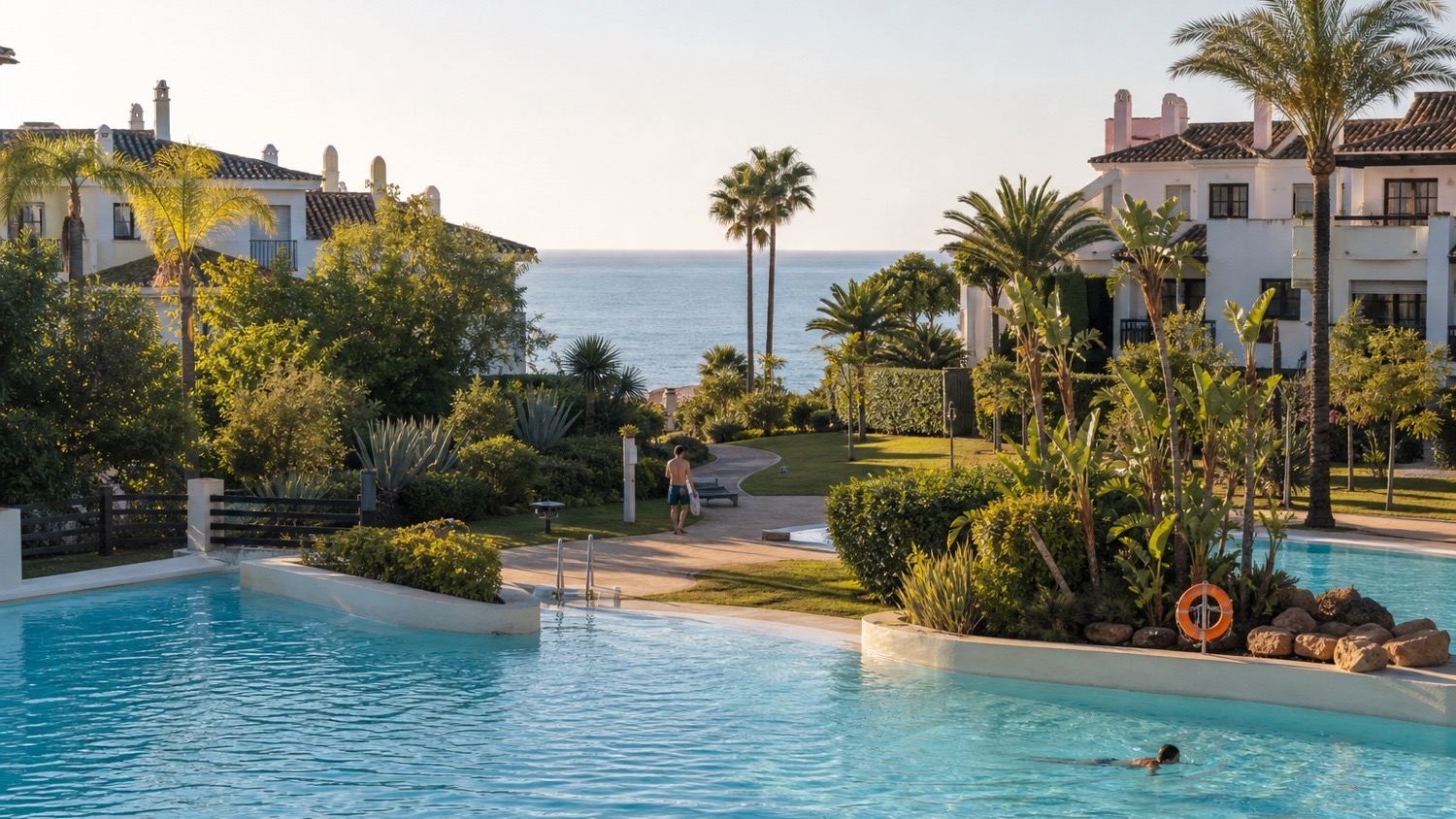
The Mediterranean coastline is part of daily life, while Benahavís, Sierra Bermeja and the Sierra de las Nieves provide mountain landscapes close to the coast. Our Benahavís guide introduces the neighbouring municipality.
Why is Guadalmansa central to this new way of living?
Guadalmansa is close to Estepona, Marbella and Benahavís for services and leisure, yet its beachfront setting feels calmer and more residential. Livingstone Estates is based here, giving our team direct experience of how its communities function through different seasons.
The established developments in Guadalmansa and along the neighbouring coastline offer more than an attractive address. Torre Bermeja, Cabo Bermejo, Las Dunas Park, Las Salinas, Las Nayades, Menara Beach and nearby Los Granados del Mar combine mature landscaping, substantial swimming pools, security and coastal access. Several also provide indoor leisure facilities valued during extended stays.
Differences in orientation, privacy, terrace exposure, storage, management and atmosphere outside summer can be more important than a development's reputation. Buyers considering longer stays should compare how each property supports their actual routine.
A different measure of value
The New Golden Mile's transformation reflects a broader change in how internationally mobile people organise work, family life and time. Global uncertainty has increased the value of optionality, remote work has loosened the relationship between home and office, and the years following Covid have moved health, space and everyday experience closer to the centre of residential decisions.
The appeal lies in how these elements come together: access through Málaga and Gibraltar, dependable services, a multicultural population and a climate suited to outdoor life. Guadalmansa adds mature beachfront communities and Livingstone Estates' specialist local knowledge.
Explore properties currently available in Estepona East and the New Golden Mile, or contact Livingstone Estates for informed guidance on the communities around Guadalmansa.
Livingstone Estates
Urb. Guadalmansa, Edif. Salinas Local 7
Ctra. de Cádiz KM 164, 29680 Estepona, Málaga, Spain
Telephone: +34 952 806 417
Email: info@livingstone-estates.com
Register today to our Guadalmansa Insider Newsletter and get all the latest updates & news about the Guadalmansa area in your inbox.
Editorial note: Population, infrastructure and market information was checked against the cited official sources on 20 August 2026. Transport arrangements, property availability and public services may change and should be confirmed directly.
Editorial disclosure: Artificial intelligence assisted with research, structure and editorial preparation. The article was fact-checked and reviewed in accordance with Livingstone Estates' editorial standards. Illustrative lifestyle images were created using artificial intelligence.


